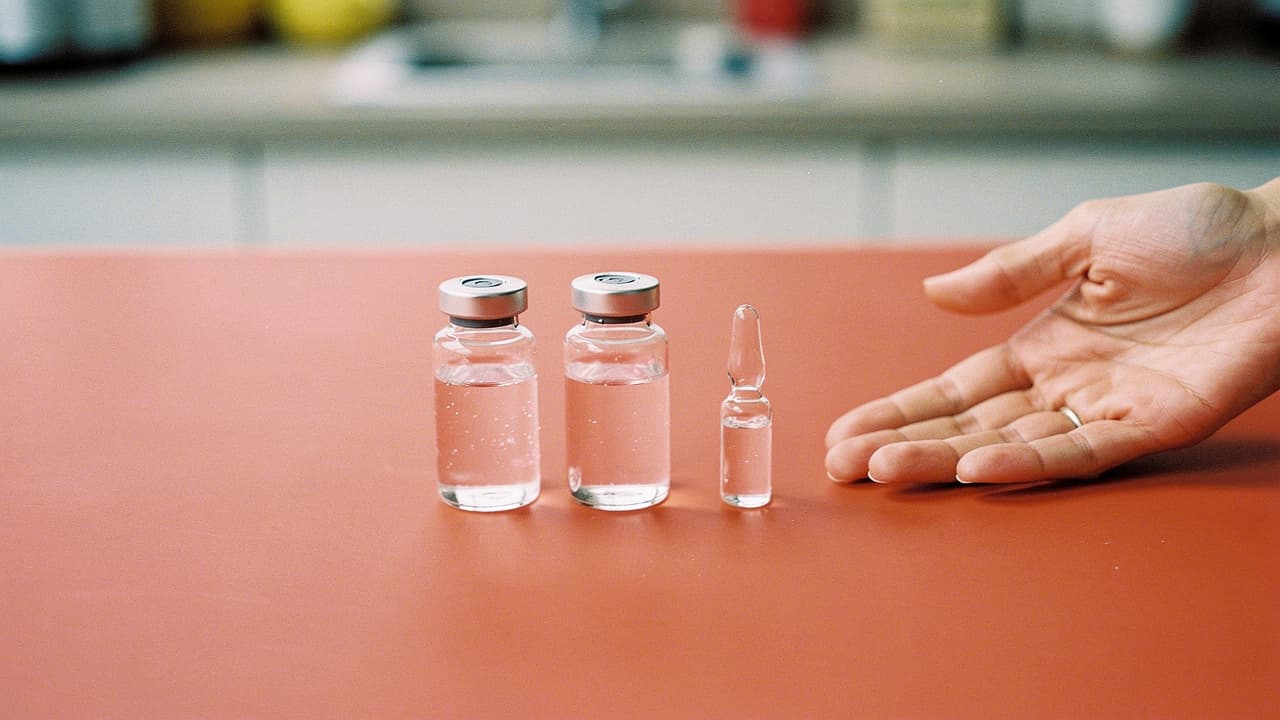
What is the AOD-9604 peptide?
AOD-9604 stands for “anti-obesity drug 9604.” Structurally it is not a novel molecule. It is a fragment of one you already make: human growth hormone is 191 amino acids long, and AOD-9604 reproduces residues 177 to 191, the C-terminal tail, with a tyrosine added at the front for stability. The 2015 analytical paper in Drug Testing and Analysis describes exactly this construction (PMID 25208511).
The design logic was specific:
- Human growth hormone has several separable activities, not one.
- Its effect on fat metabolism appeared to sit in the C-terminal region, its effects on growth and glucose elsewhere.
- If you administer only the C-terminal fragment, the reasoning went, you get the lipolytic action without raising IGF-1 or disturbing insulin sensitivity.
- That was the hypothesis. Rodent work supported it. Human work did not follow.
How does AOD-9604 work?
The proposed mechanism is not receptor binding in the way most peptide drugs work. The rodent studies point at fat oxidation and lipolytic sensitivity rather than appetite suppression, which makes it mechanistically unlike the GLP-1 medications people usually compare it to.
- Increased fat oxidation. The 2001 study in International Journal of Obesity measured substrate oxidation rates directly in obese (ob/ob) and lean C57BL/6J mice and reported increased fat oxidation with chronic treatment (PMID 11673763).
- Lipolytic sensitivity. The 2001 Endocrinology paper used beta-3 adrenergic receptor knockout mice specifically to test whether the effect ran through that receptor (PMID 11713213). Using a knockout model is how you interrogate a mechanism rather than just observe an outcome.
- Oral dosing in rats. The 2000 Hormone Research study gave obese Zucker rats an oral dose of 500 micrograms per kilogram daily for 19 days (PMID 11146367).
- Not appetite-mediated. Nothing in this literature describes AOD-9604 as a satiety agent, which is the mechanism behind the GLP-1 drugs.
What does the human research on AOD-9604 show?
This is the part most articles on this peptide get wrong, so it is worth being exact. Searching the verified literature for AOD-9604 returns rodent studies, in vitro analytical work, and review articles from the era when it was in development. It does not return a published human efficacy trial.
- The 2004 review in Current Opinion in Investigational Drugs records that Metabolic Pharmaceuticals was developing AOD-9604 for obesity and that “by February 2002, phase IIa trials were underway” (PMID 15134286).
- Reviews of the obesity pipeline in 2006 and 2007 list it among compounds in clinical development (PMID 16625817, PMID 17971763).
- So human trials were conducted. What is absent is a published primary trial reporting efficacy results, and the compound never reached approval anywhere.
- A drug that enters Phase II and then disappears from the literature is telling you something. Programs that work get published.
The honest summary: the mechanism was interesting enough to fund clinical trials, and the clinical program did not produce an approved obesity drug.
What is the evidence base, study by study?
Rather than summarising, here is the entire verified evidence set for this compound so you can see its shape:
| Year | Model | What it examined |
|---|---|---|
| 2000 | Obese Zucker rats | Oral dosing, 500 mcg/kg daily for 19 days |
| 2001 | ob/ob and lean mice | Body weight, energy balance, substrate oxidation |
| 2001 | Beta-3 AR knockout mice | Whether the lipolytic effect runs through beta-3 |
| 2004 to 2007 | Reviews | Development status within the obesity pipeline |
| 2013 | Assay study | Interaction with the WADA hGH isoform immunoassay |
| 2015 | In vitro | Detection method and metabolism |
Two of the ten entries are anti-doping analytical papers, which tells you where the scientific interest moved once the obesity program ended.
Is AOD-9604 a growth hormone?
No, and the distinction matters for anyone reading claims about it. AOD-9604 is a fragment of growth hormone, not growth hormone. The entire premise of the molecule is that it was expected to separate the fat-metabolism activity from the rest of what hGH does.
- Human growth hormone: 191 amino acids, many activities.
- AOD-9604: residues 177 to 191, plus an N-terminal tyrosine.
- The 2013 anti-doping paper found AOD-9604 does not influence the WADA hGH isoform immunoassay (PMID 24124033), which is a practical demonstration that testing does not read it as growth hormone.
- A page describing AOD-9604 as “HGH without the side effects” is describing the hypothesis, not a demonstrated human result.
What is AOD-9604’s status with the FDA?
AOD-9604 is not an FDA-approved drug, and it is not currently on FDA’s 503A Bulks List, which is the list of bulk substances a 503A compounding pharmacy may use. It was not among the peptides FDA’s Pharmacy Compounding Advisory Committee reviewed on July 23 and 24, 2026.
- Never approved as a drug in the United States.
- Never approved by any other major regulator.
- Not currently on FDA’s 503A Bulks List.
- A self-affirmed GRAS food-ingredient status exists in limited contexts. That is not a drug approval, does not establish efficacy, and does not extend to injectable use.
For the full jurisdiction-by-jurisdiction picture, including the WADA position and what reclassification would require, see the AOD-9604 legal status explainer.
Is AOD-9604 banned in sport?
Anti-doping science has taken a sustained interest in it. A detection method and in vitro metabolism study was published in 2015 (PMID 25208511), and AOD-9604 appears in the 2017 review of sports drug testing by mass spectrometry (PMID 26213263). Athletes subject to testing should treat any non-approved peptide as prohibited and confirm with their anti-doping authority rather than with a vendor.
What are the reported side effects of AOD-9604?
An honest answer has to distinguish between what was measured and what is unknown.
- The rodent studies did not report significant toxicity at the doses used, which is what you would expect to see published from a program advancing to Phase II.
- There is no published human safety dataset in the verified literature, so the long-term human side-effect profile is not characterised.
- Absence of reported harm in rodents is not evidence of human safety. It is the absence of a finding in a different species.
- Product bought outside a licensed pharmacy carries risks that have nothing to do with the molecule: unverified purity, no sterility testing, inaccurate concentration.
How does AOD-9604 compare to a GLP-1 medication?
This is the comparison most people arrive with, and the two are not close on evidence.
| AOD-9604 | Semaglutide / tirzepatide | |
|---|---|---|
| Proposed mechanism | Fat oxidation, lipolysis | Incretin signalling, appetite and gastric emptying |
| Human efficacy trials | None published | Large randomised trials |
| FDA-approved product | No | Yes, branded products exist |
| On the 503A Bulks List | Not currently | Compounded under specific conditions |
Compounded semaglutide and tirzepatide are not FDA-approved drugs either, and are not the same as the branded products. The difference that matters here is the evidence base: one of these has published human outcome trials and the other does not.
Why did the AOD-9604 obesity program stop?
No published paper announces the end of the program, so the honest answer is drawn from what the record does and does not contain rather than from a stated reason.
- The 2004 review has it in Phase IIa (PMID 15134286). Mid-2000s pipeline reviews still list it (PMID 16931496).
- After that the literature shifts entirely to analytical chemistry: how to detect it, how it metabolises, whether it interferes with existing assays.
- No approval followed in any jurisdiction, and no primary efficacy trial was published.
- The most common reason an obesity candidate stops at this stage is that the effect size in humans does not justify continuing. That is an inference from the pattern, not a documented finding, and it should be read as such.
What can be said without inference: a compound that reached Phase II two decades ago and has produced no published human efficacy result since is not an emerging therapy. It is a closed chapter that continues to circulate.
What does “research use only” mean on an AOD-9604 listing?
It is a legal posture adopted by the seller, not a quality standard and not a description of the product.
- It asserts the material is not intended for human consumption.
- It does not certify identity, purity, sterility, or concentration, and it carries no testing requirement.
- It shifts responsibility for any human use onto the buyer, which is its actual function.
- It is not equivalent to pharmaceutical-grade preparation by a licensed compounding pharmacy, where identity and sterility are verified.
- The 2015 analytical work exists precisely because material of uncertain provenance circulates and needed a detection method (PMID 25208511).
What would change the regulatory status of AOD-9604?
Two separate routes exist, and they are commonly conflated. Neither is close.
- Drug approval. A sponsor would have to run a full development program and secure FDA approval. There is no current sponsor and no completed published clinical evidence to build on.
- Addition to the 503A Bulks List. A narrower route: FDA’s Pharmacy Compounding Advisory Committee reviews nominated substances and advises on inclusion. AOD-9604 was not among the peptides reviewed at the July 23 and 24, 2026 meeting.
- Either route needs evidence that does not presently exist in the published record.
- Removal from a prohibition list is not the same as affirmative clearance. A substance sits in neither category until a determination is issued.
Why do people still search for it?
- The mechanism is genuinely interesting and was worth testing.
- “Fat loss without affecting blood sugar” is an appealing claim, and it is a real hypothesis rather than marketing invention.
- The rodent data is real, published, and reads well out of context.
- The step that is usually omitted is that the human program ended without an approved product.
What should you do if you are researching AOD-9604?
- Read the primary sources rather than vendor summaries. They are linked below.
- Note the species on every claim you encounter. Nearly all of the striking numbers come from mice and rats.
- Treat “research use only” labelling as what it is: a statement that the seller is not accountable for human use.
- If the underlying goal is weight management, that is a clinical conversation with real approved and compounded options behind it.
- Whether any therapy is appropriate is a decision a licensed clinician makes with you.
The short version
- AOD-9604 is hGH residues 177 to 191 with an added tyrosine.
- The proposed action is fat oxidation, not appetite suppression.
- Weight-loss evidence comes from obese mice and Zucker rats.
- Human trials reached Phase IIa; no efficacy trial is published.
- It is not FDA-approved and is not currently on FDA’s 503A Bulks List.
- Anti-doping testing does not read it as growth hormone.
- The long-term human safety profile is uncharacterised.