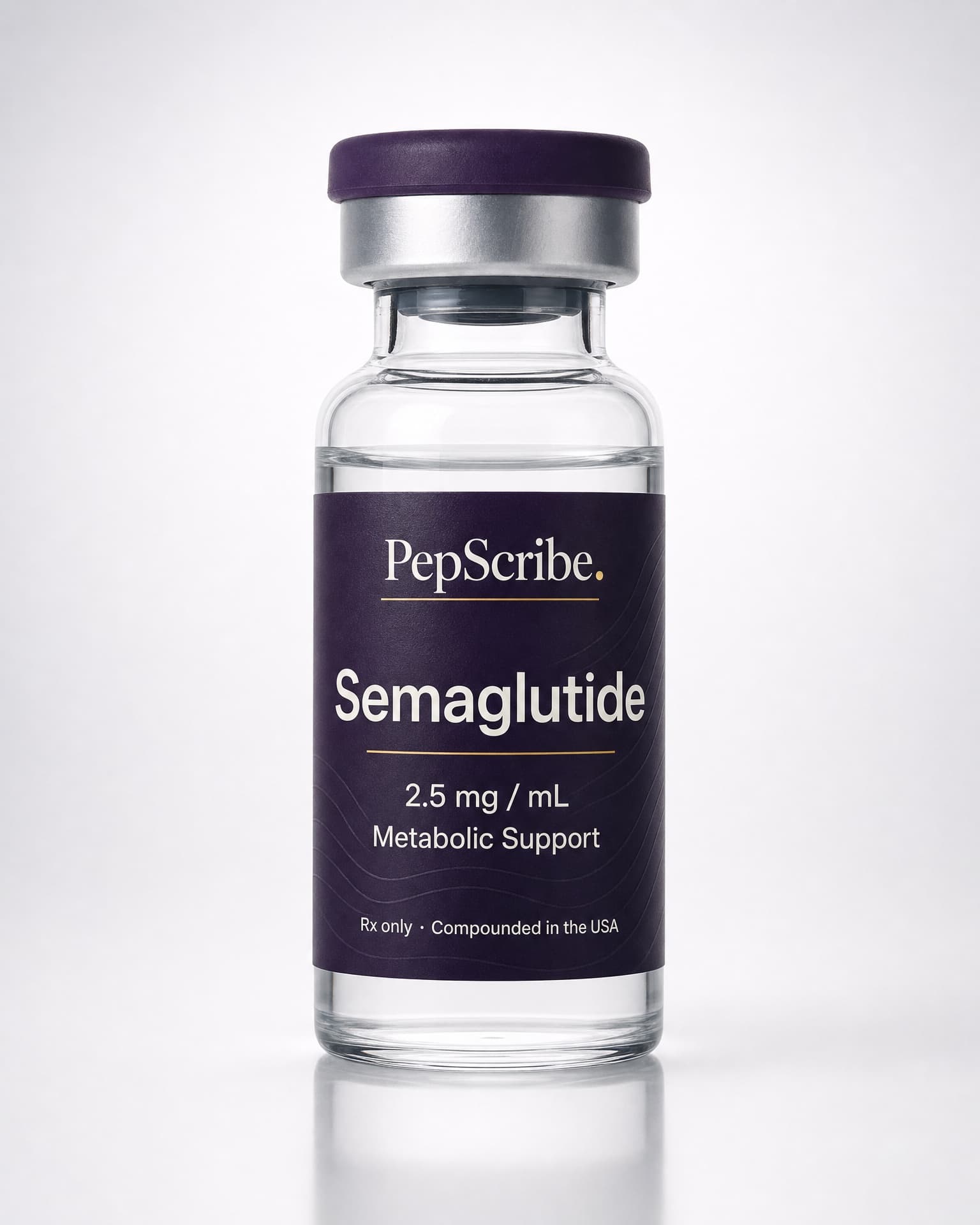
Semaglutide. The once-weekly GLP-1 injection.
A GLP-1 receptor agonist that works with your body’s appetite-regulation system. One weekly subcutaneous injection, titrated by your clinician.
Starting from
No membership fee.
- Compounded in the USA
- Filled by 503A
- Clinician-prescribed
Compounded drug products are not approved or evaluated for safety, effectiveness, or quality by the FDA. Rx required.
PepScribe is a LegitScript-certified telehealth practice. See how to verify us.

What it is
A GLP-1 receptor agonist, compounded for qualifying patients.
Semaglutide is a glucagon-like peptide-1 (GLP-1) receptor agonist. Originally developed as a therapy for type 2 diabetes, it is now widely used for weight management because of its effect on appetite regulation and glucose control.
The branded injectable forms are FDA-approved finished drugs. Compounded semaglutide is a different thing: prepared by a US-licensed 503A pharmacy under a clinician’s prescription, for patients with documented clinical need under the “not essentially a copy” framework. It is not FDA-approved.
Your dose is prepared by a US-licensed 503A pharmacy under your clinician’s prescription. No hidden overseas supply chain.
Prefer a daily tablet? Compounded oral semaglutide is also available by prescription after the same clinician review. It is not FDA-approved either.
How it works
Mechanism of action.
GLP-1 receptor agonism
Binds and activates GLP-1 receptors in the pancreas, brain, and GI tract, mimicking the body’s own post-meal satiety and glucose-regulation signaling.
Appetite suppression
Signals to the hypothalamus to reduce hunger and increase satiety. For many patients the subjective change is quieter food noise and longer fullness after meals.
Slower gastric emptying
Slows the rate at which the stomach empties, extending the physical sensation of fullness and flattening post-meal blood-sugar curves.
How long it stays in your blood
Your own GLP‑1 is gone in minutes. Semaglutide lasts for weeks.
After a meal your gut releases GLP-1, and an enzyme clears it within minutes. Semaglutide is a modified form of GLP-1 that resists that enzyme and binds albumin, a protein in your blood, so about half of a dose is still circulating a week later.
Show as a table
| Time in the blood | Natural GLP-1 | Semaglutide |
|---|---|---|
| 1 min | 74% | 100% |
| 2.3 min | 50% | 100% |
| 10 min | 4.9% | 100% |
| 1 hour | 0% | 100% |
| 1 day | 0% | 90% |
| 6.9 days | 0% | 50% |
| 7 days | 0% | 49% |
| 28 days | 0% | 5.9% |
Why it is once a week
Each dose lands before the last one is gone.
Semaglutide clears slowly, so each weekly dose arrives while part of the previous one is still in circulation. Over four to five weeks the doses stack into a steady pattern that rises and settles the same way every week.
Our standard
Compounded in the USA. Filled by licensed 503A pharmacies.
Every PepScribe dose is prepared by a licensed 503A pharmacy inside the United States, prescribed by a clinician who has reviewed your history. No hidden overseas supply chain.
Compounded in the USA
Every dose is prepared inside the United States. No hidden overseas supply chain, ever.
Filled by a 503A pharmacy
Compounded in the USA to USP standards and filled under your prescription by a licensed 503A pharmacy.
Clinician prescribed
A US-licensed clinician reviews your intake and writes the prescription. Never sold off a shelf.

Who it’s for
For adults with weight-management goals. Reviewed by a licensed clinician.
A licensed clinician reviews your intake, typically within 24 hours, and screens for the conditions below. The online visit is free; you only pay if you're prescribed, and nothing if not.
- Considered for adults with clinical eligibility for GLP-1 therapy
- Your clinician reviews your history for thyroid conditions (MTC/MEN2), pancreatitis, and pregnancy
- Not prescribed during pregnancy, active thyroid malignancy, or certain GI conditions
- Labs and vitals may be ordered; results inform dose selection and adjustments
Switching providers
Already on semaglutide? Continue at your dose.
If you take semaglutide now, your intake asks which medication you take, the dose you’re on, and when your last dose was, so your clinician sees exactly where you are.
Report where you are
The online visit is free. You tell us your current medication, the dose you're on, and how long you've been on it. Nothing is charged at booking.
Your clinician decides
A US-licensed clinician reviews your history, decides whether to prescribe, and sets your dose at your visit.
Billed by the prescribed band
If prescribed, you're charged the dose band on the schedule below that matches the prescription, not the dose you reported. Your price only rises if your dose does.
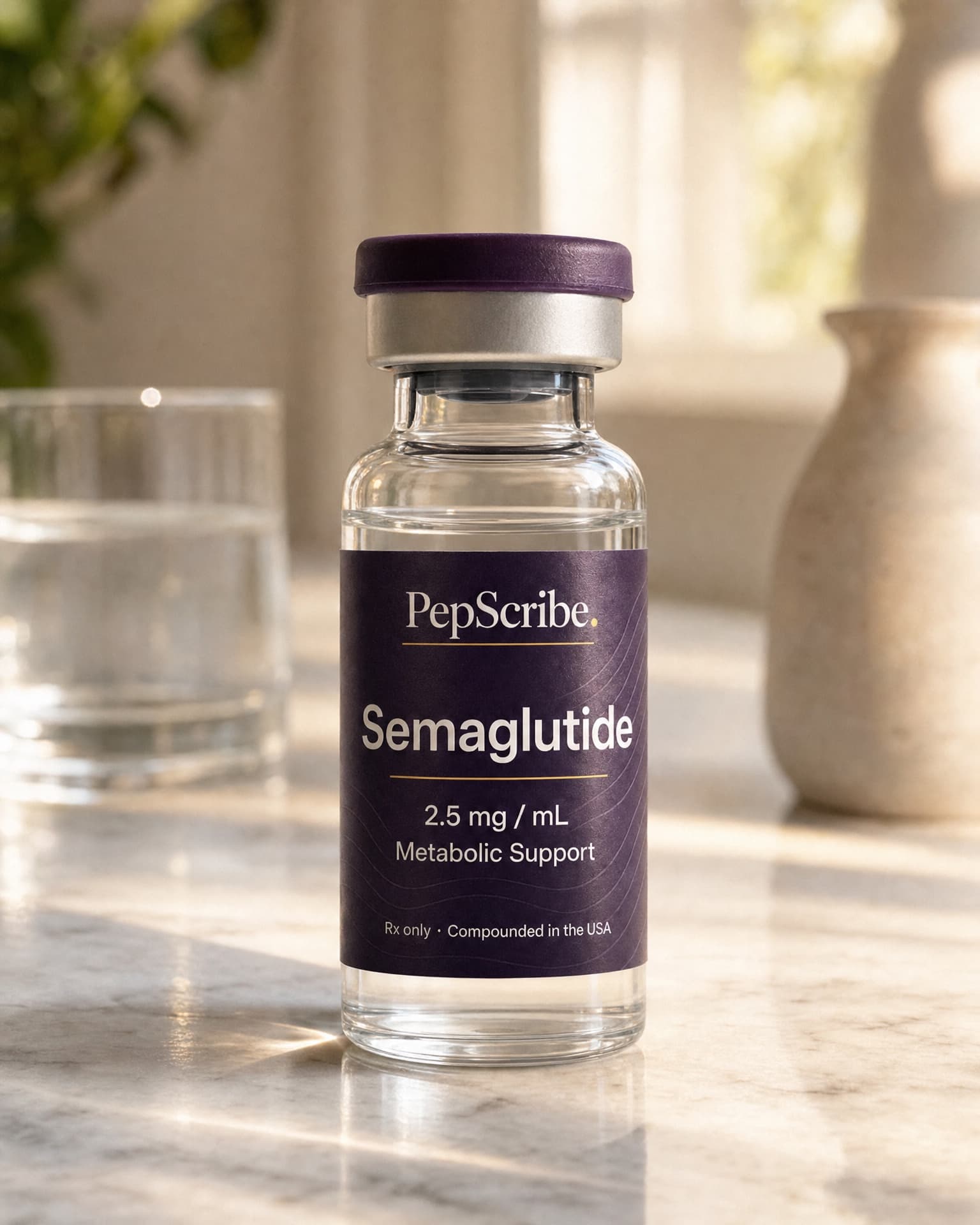
Dose-banded pricing
RxPick the plan your clinician prescribes.
Compounded semaglutide is dosed in titration steps. Your clinician selects the band based on your intake, history, and response. Lower doses are where most patients start.
Starter
0.25 – 0.50 mg
from $79/mo
Standard
1.0 – 1.7 mg
from $109/mo
Maintenance
2.4 mg
from $129/mo
The online visit is free. You only pay if a clinician prescribes. If it isn't right for you, you pay nothing.
Compounded drug products are not approved or evaluated for safety, effectiveness, or quality by the FDA. Rx required.
How the dose steps up
New plans start low and step up every four weeks.
New semaglutide patients usually start at the lowest dose and move up every four weeks, the escalation schedule used in the pivotal trial. Your clinician decides each step and can hold or lower a dose.
Show as a table
| Weeks | Weekly dose |
|---|---|
| 1 to 4 | 0.25 mg |
| 5 to 8 | 0.5 mg |
| 9 to 12 | 1 mg |
| 13 to 16 | 1.7 mg |
| 17 on | 2.4 mg |
What comes with the plan
Everything included.
One flat monthly price covers the medication, the clinical care, and the supplies. No surprise add-ons.
- Clinician-prescribed, US-licensed
- Compounded in the USA by a licensed 503A pharmacy
- Flat monthly pricing, medication included
- Supplies and injection instructions
- Async clinician messaging
- HSA and FSA eligible
Compounded semaglutide is prepared by licensed 503A pharmacies and FDA-registered facilities in the USA and is not FDA-approved. The branded injectable GLP-1 products are separate FDA-approved drugs produced by their manufacturers. All prescriptions require approval by a licensed healthcare provider. Individual results may vary.
Semaglutide questions
Things people ask before they sign up.
If something is not here, reach out, we'd rather answer it plainly than have you guess.
How is compounded semaglutide different from the branded injectable?
The branded injectable GLP-1 products are FDA-approved finished drugs made by their manufacturers. Compounded semaglutide is a separate thing: prepared by a US-licensed 503A pharmacy under your clinician’s prescription for patients with a documented clinical need. It is not FDA-approved and is not a generic copy of the branded product.
How is it taken?
A small subcutaneous injection, taken once a week. Your clinician starts you low and titrates the dose over time to manage how your body responds. Your kit includes the supplies and step-by-step instructions.
Is semaglutide available as a tablet?
Yes. Compounded oral semaglutide is a once-daily tablet, prescribed after the same clinician review and compounded in the USA by a licensed 503A pharmacy. Like the injection, it is not FDA-approved. Your clinician can talk through which form fits you.
When might I notice a difference?
Semaglutide is titrated gradually, week by week. Many patients first notice quieter food noise and longer fullness after meals in the early dose bands, with appetite changes building as the dose steps up under clinician guidance.
Is it FDA-approved?
Compounded semaglutide is not an FDA-approved drug. It is prepared by a licensed 503A pharmacy in the USA under your clinician’s prescription for patients who clinically qualify. The branded injectable GLP-1 products are separate FDA-approved drugs.
What if I am not approved?
The online visit is free; you only pay if you are prescribed, and nothing if not.
How do I get compounded semaglutide prescribed online?
Start with the free three-minute assessment. A US-licensed clinician reviews your intake within 24 hours. If they prescribe semaglutide, your dose is prepared by a licensed 503A pharmacy inside the USA and shipped as a once-weekly subcutaneous injection kit with the supplies and step-by-step instructions. It is compounded in the USA with no hidden overseas supply chain, and it is not an FDA-approved drug.
How much does compounded semaglutide cost per month?
Plans start from $79/mo, with the medication included. Pricing is dose-banded, so what you pay depends on the dose your clinician prescribes: Starter (0.25 to 0.50 mg) from $79/mo, Standard (1.0 to 1.7 mg) from $109/mo, and Maintenance (2.4 mg) from $129/mo. Your clinician selects the band based on your intake and response, and you see the exact plan price before you pay anything. The online visit is free; you only pay if you are prescribed, and nothing if not. One price covers the medication, the clinical care, the supplies, and shipping. Plans are HSA and FSA eligible.
Who prescribes compounded semaglutide, and do I need an in-person visit?
A US-licensed clinician is the prescriber of record. They review your intake assessment and write the prescription only when semaglutide is clinically appropriate under 503A compounding rules. The process is asynchronous: you complete the assessment, the clinician reviews it within 24 hours, and you can reach the care team through async clinician messaging. It is never sold off a shelf, and the online visit is free; you only pay if you are prescribed.
Is compounded semaglutide available in my state?
Availability depends on your clinical eligibility, which is determined by the free three-minute assessment and a US-licensed clinician's review of your intake. The online visit is free; you only pay if you are prescribed, and nothing if not, so you can check whether a plan is available to you at no cost.
Start a Semaglutide plan.
Three-minute assessment. A US-licensed clinician reviews it within 24 hours. The online visit is free; you only pay if semaglutide is prescribed.